Global Growth Plateaus as Economic Risks Materialize
IMF Blog, October 9, 2018
Source details
- Canonical URL
- Global Growth Plateaus as Economic Risks Materialize
Other formats
Bibliographic details
- Authors: Maurice Obstfeld
- Published: October 9, 2018
Overview and headline projections
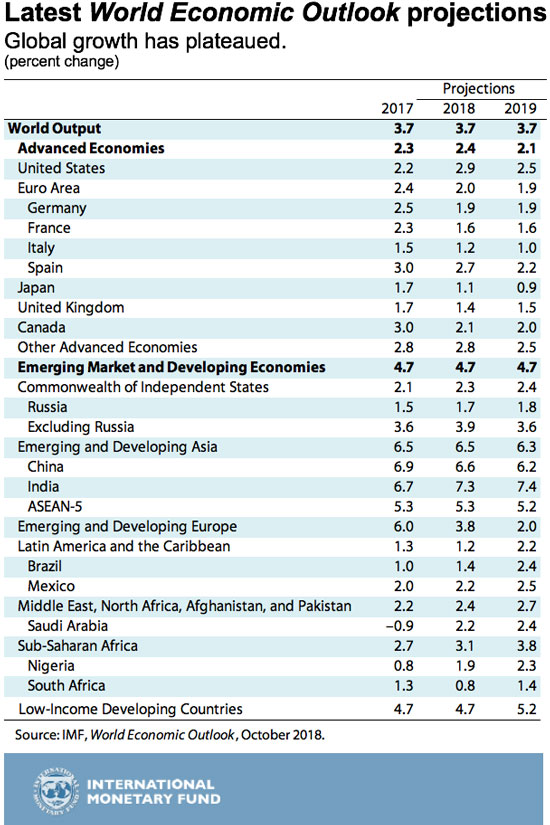
- The latest World Economic Outlook projects that global growth will remain steady over 2018–19 at last year’s rate of 3.7 percent.
- Last April’s projection was 3.9 percent for both this year and next; subsequent developments make 3.9 percent over-optimistic.
- Growth has plateaued at 3.7 percent rather than rising.
Regional and aggregate revisions
- Projected 2018–19 growth in advanced economies is 0.1 percentage point lower compared with six months ago.
- Projected revisions for emerging market and developing economies are:
- -0.2 percentage point for this year and next year for emerging market economies.
- -0.4 percentage point for this year and next year for developing economies.
- Emerging market and developing economies comprise about 40 percent of world GDP at market exchange rates.
Country-specific developments and drivers
- United States:
- Growth buoyed by a procyclical fiscal package, driving US interest rates higher.
- US growth is expected to decline once parts of fiscal stimulus go into reverse.
- 2019 US growth forecast downgraded owing to recently enacted tariffs on a wide range of imports from China and China’s retaliation.
- China:
- Expected 2019 growth is marked down.
- Domestic Chinese policies are likely to prevent an even larger growth decline than projected, at the cost of prolonging internal financial imbalances.
- Geographic diversity of negative revisions includes Argentina, Brazil, Mexico (Latin America); Turkey (emerging Europe); India (south Asia); Indonesia and Malaysia (east Asia); Iran (Middle East); and South Africa (Africa).
- Petroleum exporters that will benefit from higher oil prices include Nigeria, Kazakhstan, Russia, and Saudi Arabia.
Rising risks and financial conditions
- Advanced economies: core inflation largely quiescent and financial conditions remain easy.
- Emerging and developing economies: financial conditions have tightened markedly over the past six months.
- Contributing factors for emerging markets:
- Gradually tightening US monetary policy.
- Trade uncertainties.
- Country-specific factors for Argentina, Brazil, South Africa, and Turkey.
- Observed market effects in affected emerging economies:
- Discouraged capital inflows.
- Weakened currencies.
- Depressed equity markets.
- Pressured interest rates and spreads.
- High levels of corporate and sovereign debt built up over years of easy global financial conditions constitute a potential fault line.
- The susceptibility to large global shocks has risen; a sharp reversal for emerging markets would pose a significant threat to advanced economies.
- News-based indicators of policy uncertainty have spiked recently, even if advanced-country asset markets remain less concerned.
- Trade policy disruptions are a near-term downside risk, including uncertainty around the United States-Mexico-Canada Agreement, Brexit negotiations, US tariffs on China, and tariffs more broadly on auto and auto part imports that may disrupt supply chains.
Policy implications and recommendations
- Policymakers have an excellent opportunity to build resilience and implement growth-enhancing reforms.
- Governments need to:
- Build their fiscal buffers.
- Enhance resilience by upgrading financial regulatory regimes.
- Enact structural reforms that raise business and labor-market dynamism.
- Multilateral global policy cooperation mechanisms are under strain, notably in trade, and need strengthening.
- Governments have less fiscal and monetary ammunition than when the global financial crisis broke out ten years ago, increasing the urgency to act now.
- Despite potentially reduced “political space” in some countries, immediate action is advised to create consensus on sound policies.
Longer-term forces and structural challenges
- Advanced economies face secular challenges including:
- Slow growth of workers’ incomes.
- Perceptions of lower social mobility.
- Inadequate policy responses to structural economic change in some countries.
- Emerging market and developing economies face diverse long-term challenges:
- Improving investment environments.
- Reducing labor-market duality.
- Upgrading educational systems.
- The dangers of climate change are rapidly intensifying.
- All countries must prepare workforces for changes in the nature of work due to new technologies.
- Ensuring that growth is inclusive is critical; without more inclusive growth, centrist and multilateral approaches to politics and policy become increasingly vulnerable.
Maurice Obstfeld, October 9, 2018