|
|
Data and Statistics
Last Updated:
November 20, 2009
|
The IMF publishes a range of time series data on IMF lending, exchange rates and other economic and financial indicators. Manuals, guides, and other material on statistical practices at the IMF, in member countries, and of the statistical community at large are also available.
|
|
Most Visited Data and Statistics
|
|
World Economic Outlook Databases (WEO)
Download time series data for GDP growth, inflation, unemployment, payments balances, exports, imports, external debt, capital flows, commodity prices, more.
International Financial Statistics (IFS) 
Approximately 32,000 time series covering more than 200 countries starting in 1948. Includes exchange rates, Fund accounts and the main global and country economic indicators.
Principal Global Indicators
A website that brings together data for the major economies available from international agencies covering the financial, governmental, external, and real sectors, and provides links to data in web sites of international and national agencies.
Joint External Debt Hub
Database that brings together data on external debt and selected foreign assets available from international agencies (creditor/market sources) and external debt data available from the QEDS database (national/debtor sources).
Quarterly External Debt Statistics (QEDS)
External debt data reported by SDDS subscribers (extended to a number of GDDS economies in early 2008), with additional details on currency composition, debt service profile, and other presentations that facilitate cross-country data analysis.
Balance of Payments Statistics (BOPS) 
The BOPS yearbook includes annual aggregate and detailed time series for balance of payments and international investment position for countries; provides world and regional tables of balance of payments components and aggregates; and descriptions of methodologies, compilation practices and data sources used by individual countries. 
Coordinated Portfolio Investment Survey (CPIS)
The CPIS collects information on the stock of cross-border holdings of equities and long- and short-term debt securities broken down by the economy of residence of the issuer.
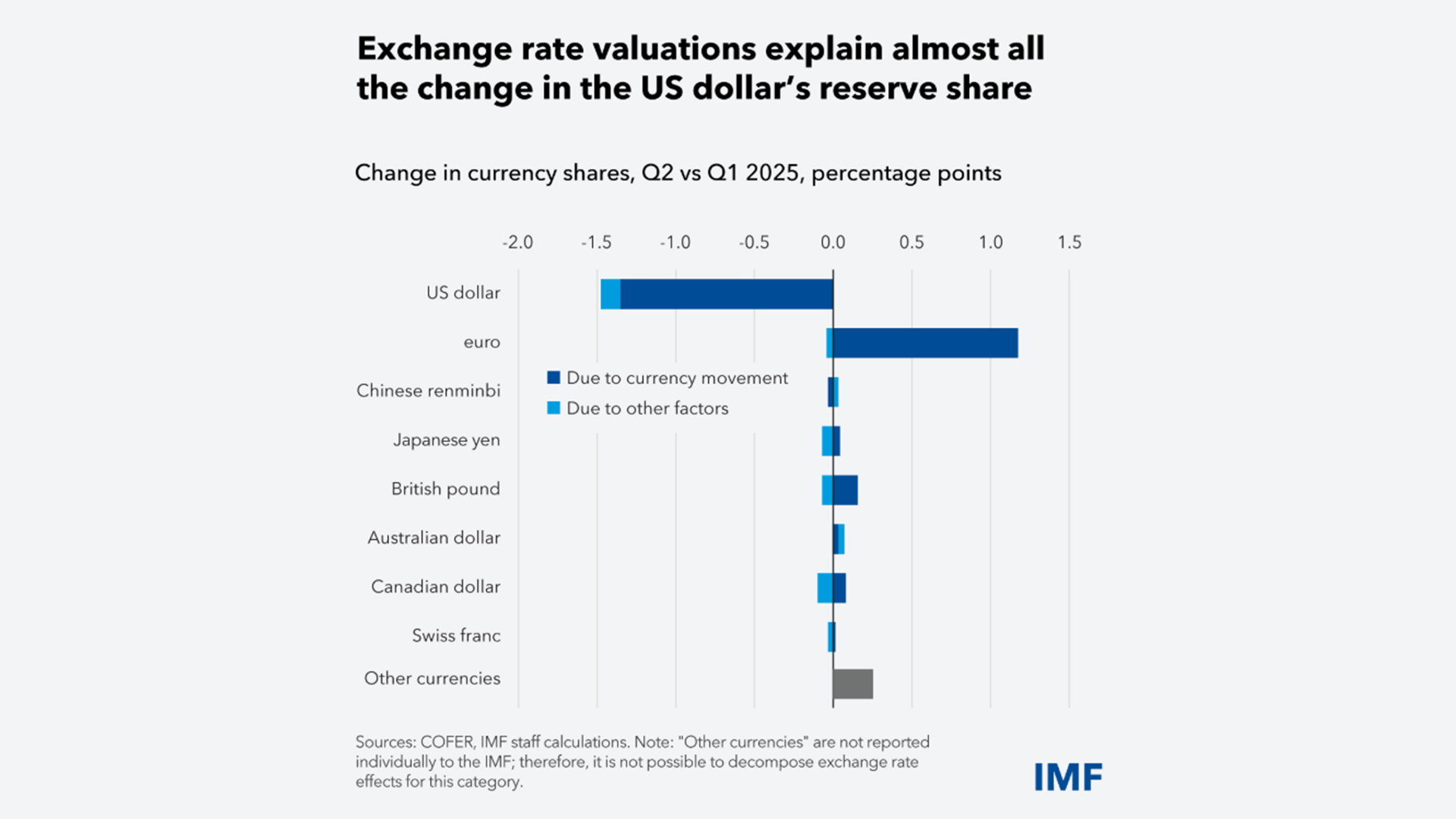
Currency Composition of Official Foreign Exchange Reserves (COFER)
End-of-period quarterly data on the currency composition of official foreign exchange reserves. Data presented in CSV and PDF are aggregated data.
|
|
|
|
Direction of Trade Statistics (DOTS) 
Provides data on the country and area distribution of countries' exports and imports by their partners.
The DOTS yearbook gives seven years of data for about 186 countries.
The DOTS quarterly covers data for the most recent six quarters and the latest year for about 156 countries, and ten quarters and five years for the world and area tables. 
Primary Commodity Prices
Indices in terms of dollars or sdrs, indices of market prices for non-fuel commodities and petroleum, actual market prices for non-fuel commodities and petroleum, and average weekly prices for non-fuel commodities and petroleum.
Data Template on International Reserves and Foreign Currency Liquidity
Re-disseminates IMF member countries' data on international reserves and foreign currency liquidity in a common template and in a common currency (the U.S. dollar). Historical data by country and selected topics are also available.
Financial Soundness Indicators (FSIs)  Provides data and detailed metadata reported on a regular basis by a first batch of member countries for 12 core and 28 encouraged FSIs. Countries may report monthly, quarterly, semiannual, or annual FSIs for dissemination. The IMF will aim over time to expand the list of reporting member countries.
Government Finance Statistics (GFS) Contains detailed annual statistical data on revenue, expense, transactions in assets and liabilities, and stocks of assets and liabilities of general government and its subsectors as reported by member countries.
Monitoring of Fund Arrangements Database (MONA) Download comparable data on the economic objectives and outcomes of Fund-supported arrangements since 2002.
G-20 Surveillance Notes Notes provided by IMF staff ahead of a series of meetings held by the G-20 deputies and ministers. They provide a summary of global economic prospects at the time of the respective meeting.
|
|
|
Dissemination Standards Bulletin Board (DSBB)
Established to guide countries in the provision of their economic and financial data to the public.
General Data Dissemination System (GDDS)
Provides recommendations on good practice for the production and dissemination of statistics. See our Guide for Participants and Users and our assessment of the last ten years of GDDS (January, 2008) . The purpose of this Guide is to explain the nature and objectives of the General Data Dissemination System, to describe its operational features, and to provide practical guidance to IMF member countries that are, or are considering, participation in the GDDS. Additional translations (Arabic, French, Russian, and Spanish) are being prepared and will be available shortly.
|
|
|
|
» External Sector Statistics
|
|
|
|
Government Finance Statistics Manual 
Covers concepts, definitions, classifications, and accounting rules, and provides a comprehensive analytic framework within which the statistics can be summarized and presented in a form appropriate for analysis, planning, and policy determination.
English | Arabic | Chinese | French | Russian | Spanish
Manual on Fiscal Transparency 
Guidance on the implementation of the Code of Good Practices on Fiscal Transparency
» Monetary and Financial Statistics
|
Monetary and Financial Statistics Manual 
Covers concepts, definitions, classifications of financial instruments and sectors, and accounting rules, and provides a comprehensive analytic framework for monetary and financial planning and policy determination.
|
Meetings and Related Statistical Materials
|
|
Recent Developments and Current Initiatives (2008) 
Reports on the activities undertaken in support of the mission of the Statistics Department of the IMF.
IMF Committee on Balance of Payments Statistics The IMF Committee on Balance of Payments Statistics was established by the IMF’s Executive Board in 1992 to improve the availability, consistency, and reliability of balance of payments and international investment position statistics worldwide.
• Annual Reports • Issues for discussion by the Committee
Working Group on Securities Databases
In July 2007, the Working Group on Securities Databases (WGSD), originally established in 1999, was reconvened in response to various international initiatives and recommendations to improve information on securities markets. The members of the WGSD are the IMF (chair), the Bank for International Settlements (BIS), the European Central Bank (ECB), and the World Bank. Selected experts from national central banks, who have participated actively in various international groups that have identified the need to improve data on securities markets, have also been invited to contribute to the deliberations of the WGSD.
The Handbook on Securities Statistics is the first publication of its kind to focus exclusively on securities statistics. Part 1 of the Handbook is now available.
Task Force on Harmonization of Public Sector Accounting
|
|
Statistical Capacity Building: Case Studies and Lessons Learned 
The studies focus on countries that were in transition and postconflict situations in the 1990s and early 2000s.
Balance of Payments Statistics Newsletters 
Information on the work of the Balance of Payments Committee and on statistical developments in balance of payments taking place in particular countries and in international organizations.
Task Force on Finance Statistics (TFFS)
The TFFS sets methodological standards for statistics on external debt and on public debt; promotes data availability on financial stocks, particularly external debt; encourages internationally accepted statistical practices to enhance data quality; and fosters inter-agency collaboration in statistical capacity building.
Users Conference on the Financial Crisis and Information Gaps The IMF and the FSB hosted a Users Conference during July 8-9, 2009 in Washington, D.C.
International experts on financial stability and statistics from primarily G-20 economies and international agencies attended. The main purpose of the conference was to solicit views of users on which data gaps were most relevant in the build up to the crisis and on proposals for strengthening data collection going forward.
• Summary • Conference website
The Financial Crisis and Information Gaps: Report to the G-20 Finance Ministers and Central Bank Governors Prepared by the IMF Staff and the FSB Secretariat.
|
|
|