Drivers of female participation
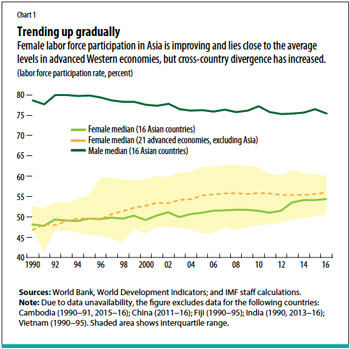
To understand the reason for better outcomes in Asia, it is important to identify where improvements have been the largest.
As populations gray, the rising share of older workers tends to lower the workforce participation rate for both men and women, as older workers tend to be less active in the workforce. Yet in Asia, despite the negative effects from aging, participation has improved for prime-age female workers—those 25–54 years of age—even as a rise in school enrollment for younger workers, both male and female, has delayed their entry into the workforce (Anh and others, forthcoming).
These trends generally hold across all Asian countries, with a few exceptions—notably China, India, and Thailand—where prime-age female workers are becoming less attached to the workforce.
The economic cycle has a strong bearing on labor market developments. Slower growth or recessions raise unemployment, which can lead workers to drop out of the labor market as they grow discouraged or their skills atrophy. Some may delay entering the job market until the economy recovers.
Asian economies have benefited from strong growth in recent years, which has supported female labor force participation and countered the effects of aging. In this regard, the Asian experience is different from that of advanced Western economies, which bore the brunt of the global financial crisis and where the ensuing economic downturn dragged down female labor force participation, adding to pressures generated by aging (IMF 2018).
But growth and aging do not entirely explain variations in female labor force participation in Asia. Structural shifts in the economy and family-
friendly policies have also played a role.
A growing body of work shows that female labor market outcomes are also the result of interrelated social, structural, and individual characteristics, as well as of labor market policies and institutions that affect labor market outcomes both generally and for female workers specifically. These factors influence people’s decision to join the workforce and employers’ decision to hire. The drivers include better infrastructure, more equal labor rights, low adolescent fertility rates, and the availability and affordability of child care, as well as cultural attitudes that affect women’s engagement in the workforce.
The impact of policies may vary depending on the structure of the economy and the stage of economic and institutional development. For instance, in more advanced economies, the extent of urbanization and postsecondary education tends to be linked with higher female labor force participation because female workers tend to be employed in higher-skill jobs in the urban service sector. These factors are less closely tied to female labor force participation rates in low-income countries characterized by high informal employment in the rural (agricultural) sector.
The group of Asian countries examined here covers a wide spectrum when it comes to the stage of economic development, labor market endowments, and policy and institutional settings. Some factors may—on average—be less important statistically in explaining changes in female labor force participation simply because they affect only smaller country subgroups.
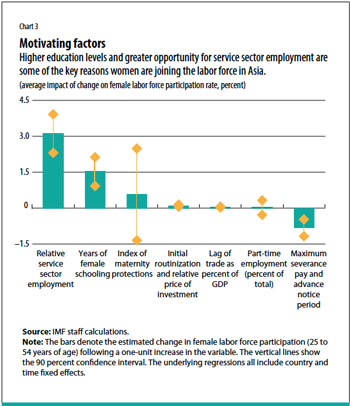
Among Asian economies, a larger service sector (including the public sector) relative to the industrial sector—and higher education levels—stand out as most closely associated with greater female labor force participation (see Chart 3). The openness of the economy (measured by the share of trade in GDP) and the pace of urbanization (not shown) have positive but smaller effects on average given the diversity of Asian countries.
While automation (or routinization) hurts female labor force participation in some countries, this is not the case across all of Asia. This is because of the relatively low exposure to routinization in some countries (given the large share of agriculture, for instance) and the high cost of automation.
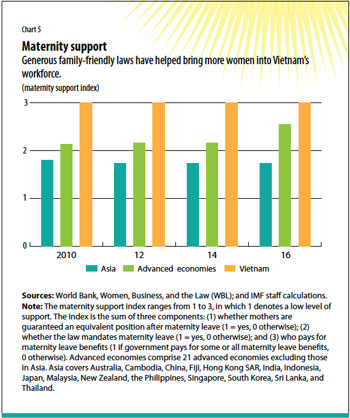
Family-friendly policies tailored to address specific constraints faced by women in the workforce—such as maternity protection, child care, and part-time employment—play a positive role. But data gaps and the large informal sector in several Asian countries limit the size of the overall effect. Moreover, the effectiveness of family-oriented policies depends on the institutional capacity to enforce legally mandated provisions, which varies across Asian countries.
Finally, labor market rigidities that make it difficult for businesses to let go of workers can have a chilling effect on employers’ decisions to hire female workers.