 That was when economists empirically demonstrated the relationship between central bank independence and price stability; politicians of all stripes paid homage to central bankers’ wisdom on market stability, international diplomacy, pension reform, and fiscal policy; and markets swooned over every last central banker comment.
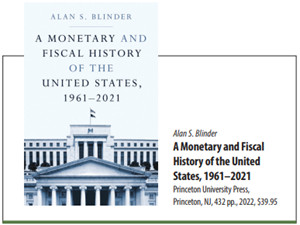
In his new book, Alan Blinder—the famed economist and former Fed vice chair involved in fiscal and monetary policy during that golden era—celebrates the wisdom of central bankers but also highlights their sometimes-ugly incursions and excursions into the world of fiscal policy.
Blinder writes with the verve for which he is justly famous. Blinderian parentheticals abound, as do biographical snippets of key players. More important, as befits an economist involved in policy for the past 40 years, the author is laser-focused on history’s implications for present policy disputes. A book of history written for our time, it has much to say about the fiscal-monetary conflicts and collaborations that continue apace, including most recently the 2020 crisis, perhaps the biggest fiscal-monetary collaboration since World War II.
Blinder’s is an avowedly (neo-)Keynesian account of the sweep of this economic history, in praise of the technocrats and their political masters, in a defensive crouch for central bank independence—confident that there are right and wrong policy answers to questions posed by the economy. Blinder would most certainly disagree with the notion, for example, that central bankers are political actors. This is, I think, the greatest weakness of his account. What we get is a strong account of politicians with profound short-term bias and technocrats serving as the intellectual counterweight whose errors were primarily—perhaps exclusively—their failure to exercise the independence their status requires.