Building a strong, equitable economy
Transforming the US economy requires policymakers to recognize that markets
cannot perform the work of government.
The first step is to eradicate COVID-19. It has to be the first priority,
not only for public health but also for the US economy. Beyond that,
encouraging a strong and sustained recovery that delivers broadly shared
growth also requires the United States to address its long-term problems: a
costly health system that leaves millions with insufficient care, an
education system designed not to end inequality but to preserve it, lack of
basic economic stability for most families, and climate change.
Major public investments are required to deal with each issue. While it is
not necessary to worry now about paying for them, the nation should put in
place significant tax increases, primarily or entirely on the wealthy, to
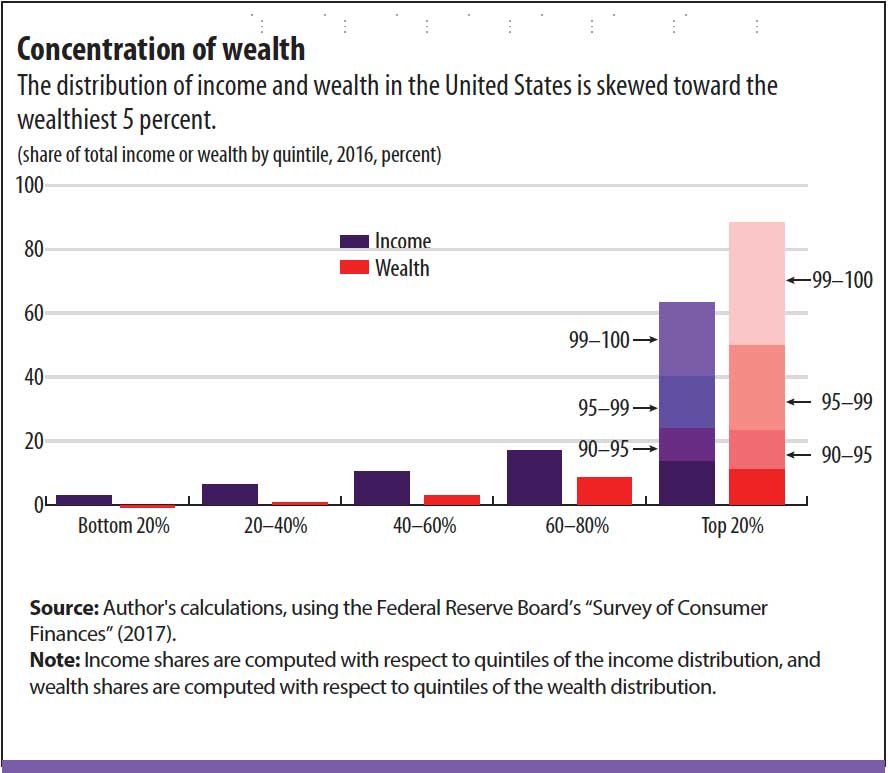
begin investing in these long-term solutions. The country should tax the
enormous wealth concentrated at the top that is being saved, or kept
overseas, and not being invested in the economy or in solving societal
problems (see chart).
Policymakers also must address the economic concentration that has created
monopsony power (a single or handful of buyers or employers) that keeps
wages down and threatens small businesses, which are the lifeblood of
innovation and economic dynamism. The first step is to ensure that the
recession and the programs designed to help businesses survive the crisis
don’t exacerbate this trend. Thus far, federal policies to address the
economic downturn have provided far greater aid to large businesses than to
small ones.
Policymakers also must ensure that federal government funds are directed to
productive uses that support workers and customers, and not to rewarding
wealthy shareholders. Corporations receiving aid should be barred from
issuing dividends and carrying out stock buybacks, and banks should be
required to suspend capital distributions during the crisis to support
lending to the real economy.
Even more fundamental to addressing excessive concentration is
strengthening US antitrust enforcement, which is weaker than it has been in
decades. The antitrust laws themselves also need to be bolstered,
particularly with respect to the rules governing mergers and exclusionary
conduct. Legislators should consider creating a digital regulatory
authority to enforce privacy laws and enhance competition in digital
markets.
The country also needs to better understand who benefits, or does not, from
recovery policies and what further actions are needed. Because overall GDP
is not up to that task, income must be disaggregated at all levels to
measure progress or lack thereof for all groups—which would enable the
United States to lay the groundwork for understanding what other actions
are needed to ensure more people benefit from the recovery.
US economic inequality is firmly tied to the issue of racial inequality.
The unmistakable message of the Black Lives Matter movement is that
Americans of color never have been able to trust government to act on their
behalf. Government must work to ensure that low-income Black, Latinx, and
Native American people can both develop and deploy their talents and skills
in the economy.
Taxing wealth, which is disproportionately owned by White Americans, is one
solution. But for that to address racial inequities adequately, the
proceeds of the wealth tax must benefit the majority of the nonwealthy. The
proceeds must be directed to the most urgently needed investments, such as
in COVID-19 testing and treatment in communities of color, in policies that
expressly and progressively support low-wage workers and care workers, and
in engagement with minority-owned small businesses. Otherwise, pervasive
inequities will be further entrenched.
A significant reason for the gender earnings gap is the lack of a national
paid family and medical leave policy and the absence of a national program
to ensure that families have access to quality, affordable
">
childcare and
prekindergarten education. Families with children that do not have access
to paid leave and childcare—or cannot afford them—have little choice but to
put careers on hold. This happens to women far more often than to men.
Legislation has been introduced in Congress to accomplish both of these
goals, and these measures should get serious consideration in the next
Congress.