Middle East and North Africa’s Commodity Importers Hit by Higher Prices
IMF Blog, May 24, 2022
Source details
- Canonical URL
- Middle East and North Africa’s Commodity Importers Hit by Higher Prices
Other formats
Bibliographic details
- Authors: Jihad Azour, Jeta Menkulasi, Rodrigo Garcia-Verdu
- Published: May 24, 2022
Key impacts of higher commodity prices
- Oil prices leaped to a peak of $130 per barrel following Russia’s invasion and are expected to settle at an annual average of around $107 in 2022, up $38 from 2021, according to the IMF’s latest World Economic Outlook.
- Food prices are expected to increase by an additional 14 percent in 2022, after reaching historical highs in 2021.
- Inflation in the region (Middle East and North Africa) is projected to remain elevated in 2022 at 13.9 percent—a significant upward revision relative to previous projections in October.
- Food accounted for about 60 percent of last year’s increase in headline inflation in the Middle East and North Africa, excluding the countries of the Gulf Cooperation Council.
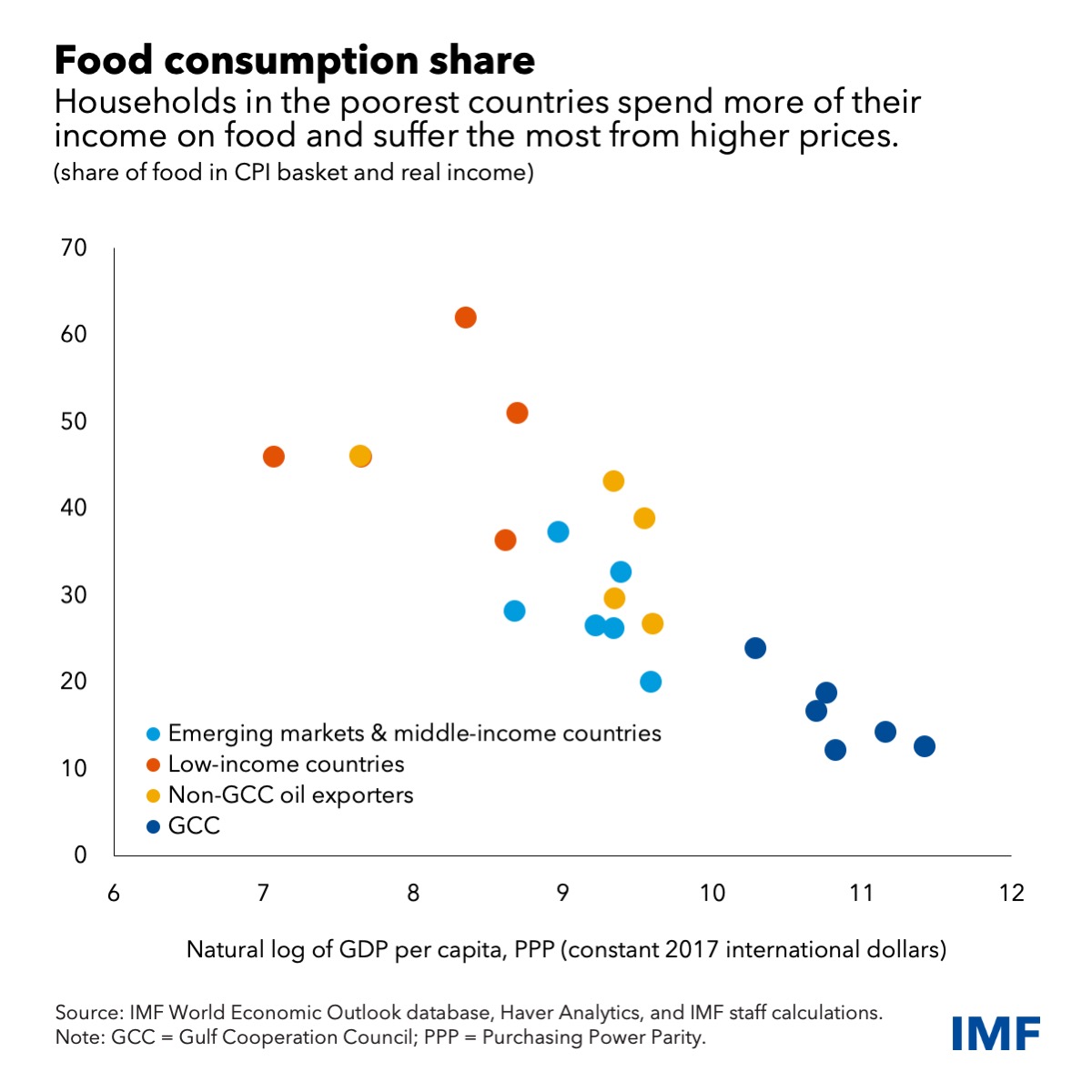
- Many economies in the region depend on foreign food shipments (about one-fifth of total imports), and food weight in consumption baskets is more than one-third on average and even higher in low-income countries.
- Strategic reserves in fragile and conflict-affected states cover less than 2.5 months of net domestic consumption.
- Commodity price increases will deteriorate current account balances for oil-importing countries by 1 percentage point of GDP, on average.
- For low-income countries, higher wheat prices alone will worsen current accounts by around 1.2 percent of GDP on average.
- Energy subsidies alone could increase by up to $22 billion for oil-importing countries in 2022.
Macro outlook and distributional effects
- The IMF revised up the forecast for growth in the Middle East and North Africa as a whole by 0.9 percentage points to 5 percent, reflecting improved prospects for oil exporters helped by rising oil and gas prices.
- For oil-importing countries, projections were marked down due to higher commodity prices compounding elevated inflation and debt, tightening global financial conditions, uneven vaccination progress, and underlying fragilities and conflict in some countries.
- Rising food prices and potential wheat shortages disproportionately affect the poor (who allocate a higher share of expenditure to food), increasing poverty and inequality and heightening the risk of social unrest.
- Fragile and conflict-affected states face particular concern given limited strategic reserves and heightened food insecurity due to dependence on wheat imports from Russia and Ukraine.
Policy responses observed
- Some countries are using targeted measures to ease burdens on their populations.
- Other countries have resorted to broader subsidies and price controls to limit inflationary effects of higher international prices; however, these measures will worsen fiscal balances in the absence of offsetting measures.
- In addition to existing subsidies, some countries have introduced direct transfers and lower tariffs on food, which will add to fiscal costs.
IMF policy recommendations for oil-importing countries
- Contain inflation as a key priority, even amid fragile recoveries.
- In countries where there are risks of inflation expectations rising or price pressures broadening, policy rates need to increase.
- Clear and transparent communication is critical to guide markets.
- Address food security risks and mitigate the impact of high international prices on the poor.
- Ensure vulnerable households are protected with targeted, temporary, and transparent transfers.
- Where safety nets are less strong, raise prices gradually.
- For low-income countries, sustained financial support from the international community is crucial.
- For countries with high debt, accompany support measures with offsetting measures elsewhere—examples include cutting unnecessary spending, promoting additional tax equity, or a combination of the two—to safeguard debt sustainability given limited fiscal space.
- Coordinate fiscal and monetary policies and anchor them in credible medium-term policy frameworks to ease trade-offs.
- Press ahead with structural reforms to bolster resilience and accelerate recovery:
- Bolster the efficiency of government expenditure and revenue collection, including through digitalization.
- Promote private sector activity.
- Strengthen social safety nets.
IMF support
- The IMF will continue to help countries throughout the Middle East and North Africa adapt macroeconomic policies to new geopolitical realities through policy advice, financing, and capacity development.
Source: IMF blog post “Middle East and North Africa’s Commodity Importers Hit by Higher Prices,” May 24, 2022.