The COVID-19 pandemic is crippling the economies of rich and poor countries
alike. Yet for many low-income and fragile states, the economic shock will
be magnified by the loss of remittances—money sent home by migrant and
guest workers employed in foreign countries.
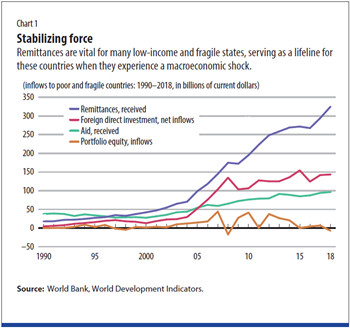
Remittance flows into low-income and fragile states represent a lifeline
that supports households as well as provides much-needed tax revenue. As of
2018, remittance flows to these countries reached $350 billion, surpassing
foreign direct investment, portfolio investment, and foreign aid as the
single most important source of income from abroad (see Chart 1). A drop in
remittance flows is likely to heighten economic, fiscal, and social
pressures on governments of these countries already struggling to cope even
in normal times.
Remittances are private income transfers that are countercyclical—that is,
they flow from migrants into their source country when that country is
experiencing a macroeconomic shock. In this way, they insure families back
home against income shocks, supporting and smoothing their consumption.
Remittances also finance trade balances and are a source of tax revenue for
governments in these countries that rely on value-added tax, trade, and
sales taxes (Abdih and others 2012).
In this pandemic, the downside effect of remittances drying up calls for an
all-hands-on-deck response—not just for the sake of the poor countries, but
for the rich ones as well. First, the global community must recognize the
benefit of keeping migrants where they are, in their host countries, as
much as possible. Retaining migrants helps host countries sustain and
restart core services in their economies and allows remittances to
recipient countries to keep flowing, even if at a much-reduced level.
Second, donor countries and international financial institutions must also
step in to help migrant-source countries not only fight the pandemic but
also cushion the shock of losing these private income flows, just when
these low-income and fragile countries need them most.
Transmission of shocks
Remittances are income flows that sync the business cycle of many recipient
countries with those of sending countries. During good times, this
relationship is a win-win, furnishing much-needed labor to fuel the
economies of host countries and providing much-needed income to families in
the migrants’ home countries. However, this close business cycle linkage
between host and recipient countries has a downside risk. Shocks to the
economies of migrant-host countries—just the sorts of shocks being caused by the coronavirus pandemic—can be
transmitted to those of the remittance-recipient countries. For example,
for a recipient country that receives remittances representing at least 10
percent of its annual GDP, a 1 percent decrease in the host country’s
output gap (the difference between actual and potential growth) will tend
to decrease the recipient country’s output gap by almost 1 percent (Barajas
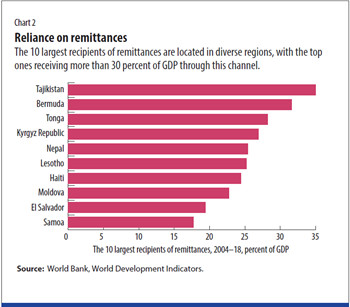
and others 2012). Remittances represent much more than 10 percent of GDP
for many countries, led by Tajikistan and Bermuda, at more than 30 percent
(see Chart 2).
The pandemic will deliver a blow to remittance flows that may be even worse
than during the financial crisis of 2008, and it will come just as poor
countries are grappling with the impact of COVID-19 on their own economies.
Migrant workers who lose their employment are likely to reduce remittances
to their families back home. Recipient countries will lose an important
source of income and tax revenue just when they need it most (Abdih and
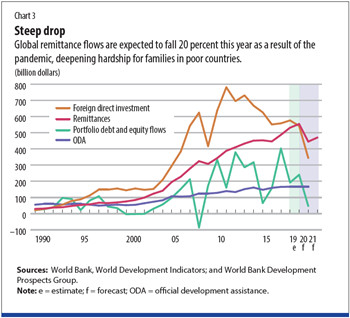
others 2012). In fact, according to the World Bank, remittance flows are
expected to drop by about $100 billion in 2020, which represents roughly a
20 percent drop from their 2019 level (see Chart 3). Fiscal and trade
balances would be affected, and countries’ ability to finance and service
their debt would be reduced.
Banks in migrant-source countries rely on remittance inflows as a cheap
source of deposit funding since these flows are altruistically motivated.
Unfortunately, these banks are now likely to see their cost of operations
increase, and their ability to extend credit—whether to the private sector
or to finance government deficits—will be greatly reduced (Barajas and
others 2018). Furthermore, the typically credit-constrained private
sector—mostly comprising self-employed people and small and medium-sized
enterprises—is likely to lose remittance funding, in addition to dealing
with even tighter credit conditions from banks. All this will come on top
of lower demand for their services and products as a result of the crisis.
That’s not all. A prolonged crisis could worsen pressure in labor markets
of rich countries, and out-of-work migrants could lose their resident
status in host countries and be forced to return home. For example, in Gulf
states such as Saudi Arabia and the United Arab Emirates, which rely on
migrant labor from the Middle East, North Africa, and Southeast Asia, the
drop in the price of oil and economic activity could result in migrants
(some of whom are already infected with the virus) returning home. They are
likely to join the jobless in their home countries—in labor markets already
brimming with unemployed youth—as well as put more pressure on already
fragile public health systems. This could heighten social pressure in
countries already ill prepared to deal with the pandemic and possibly also
fuel spillovers beyond their borders. People escaping tough situations in
their own countries are likely to seek other shores, but richer countries,
also in the midst of fighting the virus, may have very little desire to
allow migrants in—potentially leading to an even greater refugee crisis.
Global threat
Compared with previous economic crises, this pandemic poses an even greater
threat to countries that rely heavily on remittance income. The global
nature of this crisis means that not only will recipient countries see
remittance flows dry up, they will simultaneously experience outflows of
private capital, and maybe a reduction in aid from struggling donors.
Typically, when private capital flees a country because of a macroeconomic
shock, whether climate related or because of a deterioration in the
country’s terms of trade, remittance flows come in to lessen the impact of
capital flight. By contrast, in this current crisis, poor countries can
expect to experience both phenomena—capital flight as well as a drop in remittance flows.
With global demand likely to suffer, it would be hard for
remittance-recipient countries to export their way out of this crisis.
Currency depreciation cannot be expected to spur demand for their exports
or attract tourism since this shock is systemic (Barajas and others 2010).
Currency weakness will likely worsen the economic situation for many of
these low-income and fragile states whose debt is in foreign currency,
further depressing local demand and resulting in greater shrinkage of local
economies.
What can be done?
The crisis has the unique effect of tightening fiscal constraints in
low-income migrant-source countries just when there’s much more for the
public sector to do, both in terms of protecting the population from the
pandemic and supporting local economies in weathering huge negative shocks.
The loss of tax revenue resulting from the drop in remittance-supported consumption will only make things worse for governments already
strapped for funds and severely strain their ability to engage in
countercyclical fiscal measures. This creates tremendous urgency for the
international community to help, even when rich countries are themselves
facing huge fiscal burdens.
It is in the best interest of rich countries for migrants not to
go home as well as to provide resources for poor countries to fight the
pandemic. Infection rates are much higher in rich countries and are
especially high among migrant workers owing to their dismal working and
housing conditions. Migrants who go home are at risk of taking the virus
with them. If this happens, poor countries will provide a rich incubator
for the virus that will boomerang as refugees seek new shores. Then it will take decades—and many lives—for the world to be rid of this virus.
Three key actions need to be taken now.
First, host countries need to stabilize the employment
opportunities of the migrant workers in their economies.
Relief packages that target employment protection for citizens in rich
countries can also help migrant workers remain employed. Recognizing the
need to protect and stabilize the welfare of migrant workers, the prime
minister of Singapore recently assured migrant workers in his country that
“we will look after your health, your welfare, and your livelihood. We will
work with your employers to make sure that you get paid and you can send
money home . . . This is our duty and responsibility to you and your
families.” Action by host countries can help keep the remittance lifeline
alive, as well as reduce the likelihood of migrants returning home.
Extending protection to migrants will also help advanced economies get back
to full production sooner. If host countries send migrants back, it will
take even longer to restore production in rich countries to former levels.
In countries such as the United States that depend on seasonal labor,
keeping migrants within their borders and enhancing testing for infection
will bring a double benefit—ensuring the supply of fresh agricultural
products for the host country and preserving remittances for migrants’ home
countries.
Second, countries receiving returning migrants will need help to
contain, mitigate, and reduce the escalation of outbreaks.
Donor countries must help with the cost of virus mitigation, in an effort
to lessen the severity of the crisis in local economies and stave off
potential spillovers. Returning migrants are likely to place further stress
on the health care systems of migrant-source countries, which are
struggling to contain local infections and avoid a shutdown of the local
economy. Authorities in these countries will need enhanced testing as much
as possible in urban areas, as well as support in implementing quarantine
measures for returning migrants who may be infected. If the return of
migrants is handled in this manner, there could be longer-term benefits for
their home countries as well. Migrants who expect to be permanently
repatriated may bring their savings with them, and their work skills could
bring development benefits to their home countries.
Third, given that poor countries’ governments have limited room for
maneuver, these countries will need the assistance of international
financial institutions and the donor community.
International financial institutions need to shore up fiscal and balance of
payments assistance to these countries. This should include ensuring that
these countries’ most vulnerable people—those most reliant on remittance
inflows for their consumption and well-being—are able to access social
insurance programs. And, perhaps now more than ever, the global effort to
meet Sustainable Development Goal 10, reducing the high cost of remittances
to 3 percent, could take center stage.
This crisis makes it clear that as a global community we, rich and poor
countries, are all in this together. We can either lift all boats or,
together, face the consequences of rising social inequality.