Keeping active in Japan
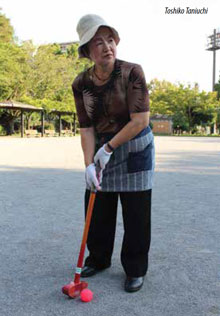
Toshiko Taniuchi participated in Japan’s post–World War II economic
miracle, as a growing population helped fuel a rapid expansion in output.
She ran a shop in Tokyo while raising three children. Today, Taniuchi is
retired, and the trend has reversed. An aging and shrinking population is
weighing on economic growth.
Taniuchi, now 79 years old, has lived with her son and his family since her
husband’s death several years ago. She worries about being a burden on her
family, so she strives to stay fit and healthy.
"I exercise and keep active to try not to cause my children too much
trouble," she says. She also visits a physical therapist to recover from a
back operation. "Luckily there’s a bus that stops a 10-minute walk away
from the rehabilitation center, and that short walk helps me stay fit."
Taniuchi keeps to a strict schedule, starting her day with exercises from a
radio program at 6:30 a.m. She goes to karaoke three times a month,
calligraphy on the first Saturday of every month, drawing on the third
Tuesday, and ground golf—a type of croquet—once a week. Then there are
community events, like local disaster drills and neighborhood cleanup
drives.
"I try to do these things and exercise to avoid getting dementia," she
says. "I make sure I’m doing different things instead of sitting watching
TV, cleaning, and doing laundry."
Japan famously has the world’s oldest population, with people 65 and older
accounting for about 27 percent of its 127 million people, according to
government estimates, up from 9 percent in 1980. The proportion of elderly
people is forecast to rise almost to 40 percent by 2050.
The demographic shift is putting pressure on Japan to improve productivity
and expand the labor force, which could be done by bringing in more women
and older workers. That would require eliminating disincentives to
full-time and regular work and making childcare and eldercare more widely
available to free people from domestic duties, according to the IMF’s July
2017
country report on Japan.
Taniuchi was born in Fukushima, a prefecture about a two-hour-plus drive
northeast of Tokyo known for excellent mountain hiking and centuries-
old onsen, or hot-spring baths. She moved to Tokyo in 1954,
married, and opened a grocery store. Today, she shares a three-story home
with her son, an office worker, and his wife and children. She rents out
the ground floor to a local business.
Taniuchi maintains an active social life, helping her friends avoid the
loneliness and isolation of many elderly Japanese. About 15 percent of men
over 65 and 5 percent of women say they go as long as two weeks without
talking to anyone, according to a nationwide survey conducted in August.
More than 30 percent of men and 9 percent of women in the same age group
said they have no one to rely on in their day-to-day lives.
"If I’m alone at home I like to go visit my friends who are also at home
alone," she says. Recently, she visited a female friend who is confined to
a wheelchair and cannot leave the house. Her friend hadn’t spoken to anyone
all day.
Finances are a concern for many older people in Japan, as they are for
other age groups. Among those in the national survey who said living
circumstances were somewhat difficult, difficult, or very difficult,
40-year-olds were the biggest group, at 38 percent. The 60-year-olds were
next, at 37 percent.
Taniuchi’s expenses are high: there’s medical insurance, fire insurance,
and mortgage payments on her house, which aren’t covered by the rental
income from the ground floor.
Still, "I can get by in my current circumstances," she says. "I get help
from my children."
PETER LANGAN
is a freelance journalist based in Tokyo. He was formerly Tokyo bureau
chief for Bloomberg News.